

A product catalogue is only useful if it matches today’s prices, today’s products, and today’s images. Rebuild one by hand for every brand and it is out of date before it ships. So we set out to show a different way: generate the catalogue from live data, on demand, in a single click.
What we built
We put together a simple web page listing a set of brands. Each brand carried its own product data, images, descriptions, and a rate card, all drawn from a product master. Next to each brand sat one button: Generate catalogue.
Press it, and the page sends that brand’s data as JSON to a single Conga Composer template. Composer merges the data into the template and returns a finished, branded catalogue to download, with the descriptions, the product images, the website link, and the full rate card laid out cleanly.
The interesting part is what happens when you switch brands. The same button, pointed at a different brand’s data, produces a different catalogue from the same template. The layout stays consistent. Only the data changes. One template, every brand.
Why it matters
Two things make this more than a neat trick.
First, the catalogue is never a stale copy. Because it is generated from the product master at the moment you ask for it, the prices, products, and images are always current. You maintain one template instead of a folder of near-identical files that quietly drift apart.
Second, none of it touched a CRM screen. The trigger and the data lived in a plain web page. The Composer API accepts a JSON payload from any system, so document generation can sit wherever your data already is: a web app, a customer portal, an ERP, or an internal tool.
How it works, briefly
The pattern is simple to reason about:
- Send your data as a JSON payload.
- Merge it into a Microsoft Office template that your team designs, using merge fields.
- Get a finished document back, as a PDF or Office file, with control over the file name and where it goes next: download, email, or straight into SharePoint or Box.
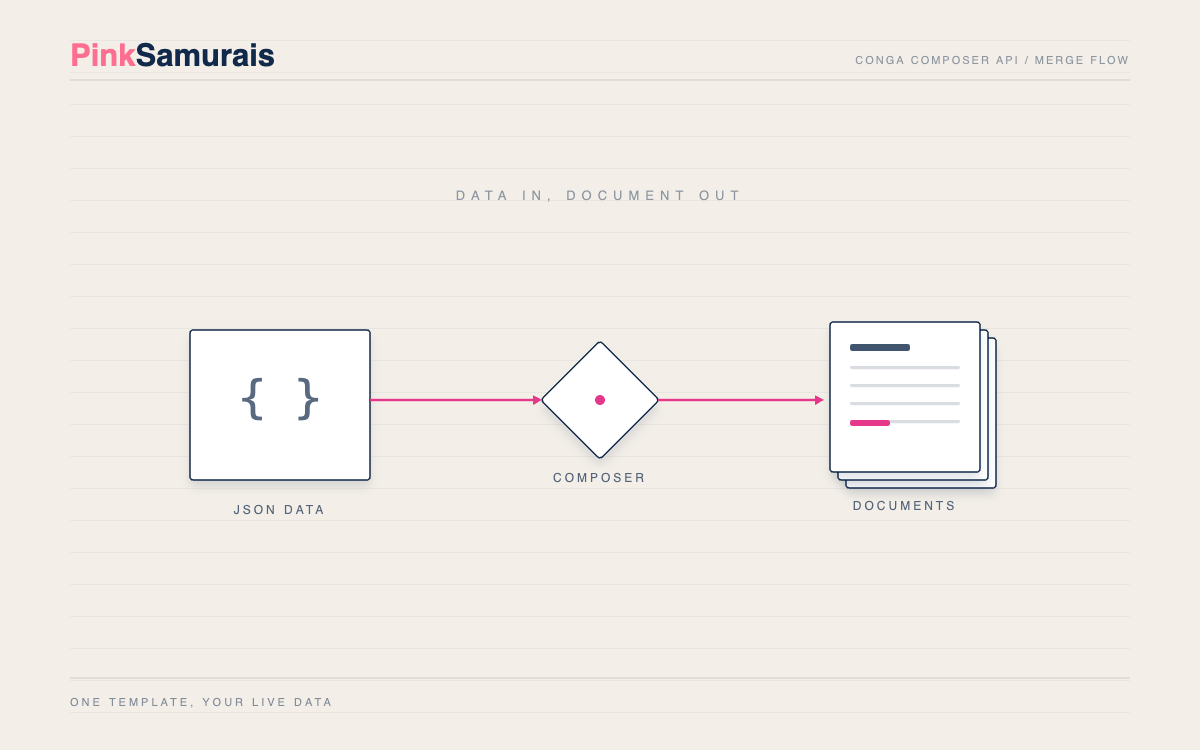
Design the template once, point it at your data, and every catalogue builds itself.
Good to know
You do not need CRM to use it, the API takes data from anywhere. It handles volume comfortably, since each job runs asynchronously and Conga offers a high-volume generation API for large batches. And the same approach works well beyond catalogues, for quotes, order forms, statements, and more.
The takeaway
If your team still rebuilds catalogues or rate cards by hand for every brand or price change, this is exactly the work the Composer API removes. One template, your live data, a finished document on demand.
We are a Conga partner and build this kind of automation for a living. Talk to us about Conga Composer.
PinkSamurais is a Conga Certified Partner. If you are weighing up template rationalisation or generation at volume, our Conga Composer and document automation services page sets out how we approach it.