

For software and subscription businesses, the journey from a signed contract to recognised revenue spans sales, operations, finance, and accounting. This end-to-end cycle, quote-to-cash, should be simple: make the sale, raise invoices, collect payment, recognise revenue, close the books. In practice, it is where some of the most expensive operational problems in the business quietly live.
This is the complete guide to executing quote-to-cash well: the challenges that fragmented operations create, the billing scenarios you have to support, the cost of getting it wrong, and what a unified revenue operations capability looks like. If you want the sharper, faster read on the single biggest source of value here, start with our focused piece on where revenue leakage hides, then come back for the full picture.
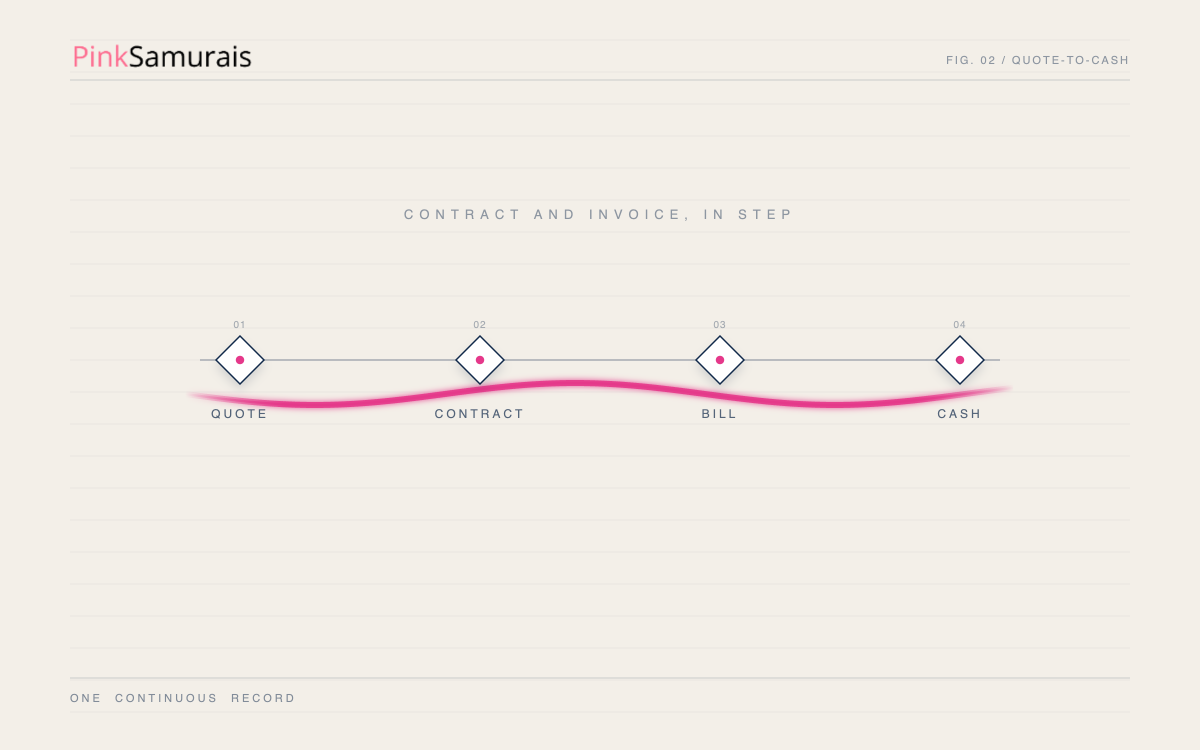
Table of Contents
| Section | |
|---|---|
| 1) | Why quote-to-cash execution matters now |
| 2) | The five challenges of fragmented operations |
| 3) | The billing scenarios you have to support |
| 4) | The cost of fragmentation |
| 5) | Fragmented vs unified: a side-by-side comparison |
| 6) | What a unified revenue operations platform looks like |
| 7) | Building the business case |
| 8) | Frequently Asked Questions |
1) Why quote-to-cash execution matters now
The revenue realisation process requires managing several things at once: contract terms and pricing logic, billing models that range from simple subscriptions to complex usage-based pricing, multi-jurisdictional tax (VAT, GST, sales tax), revenue recognition standards (ASC 606 and IFRS 15), and accurate forecasting for the board and investors. Most organisations built this infrastructure over years or through acquisition, leaving a patchwork of disconnected systems where no single platform holds the complete customer financial picture.
Three shifts have made execution more critical. Business models have grown more complex, moving from flat monthly subscriptions to tiered, usage-based, and hybrid pricing. Growth strains infrastructure: processes that work for 50 customers and one pricing model break under 500 customers and five. And scrutiny has risen, with tighter revenue recognition and higher expectations on forecast accuracy. The cost of getting quote-to-cash wrong has gone up.
The upside is real. Aligning the revenue operations chain (the function now widely called RevOps) is consistently linked by analysts such as Forrester to stronger growth and margins. But the headline benefit is more basic: you bill what you are owed, when you are owed it, and you can see it coming.
2) The five challenges of fragmented operations
Challenge one: system fragmentation and data silos
Sales automation, contract lifecycle management, ERP, and billing each do their job in isolation, but the joins between them are weak. The contract lives in one system, billing configuration in another, usage data in a third, financial records in a fourth. The result is information asymmetry and manual reconciliation, with a typical cycle running several business days and delaying the close.
Challenge two: manual process dependencies
Even with billing systems in place, teams still intervene by hand to validate configuration against contract terms, run billing, handle amendments, check tax compliance, and chase payment. That manual dependency extends Days Sales Outstanding, introduces error, and applies business rules inconsistently across customer segments.
Challenge three: financial reporting opacity
Finance leaders struggle to answer basic questions reliably: what is our committed revenue for the next twelve months, how much is at risk from contract changes, and where are we leaking? In fragmented environments, getting a defensible answer can take days of manual analysis, which undermines forecasting and audit readiness.
Challenge four: revenue leakage and pricing integrity
When contracted pricing differs from what is actually billed, revenue leaks. The usual causes are unconfigured pricing escalations, expired discounts that keep running, and amendments that never reached the billing system. Analysts including MGI Research and EY put the typical cost at roughly 1 to 5% of revenue, with MGI estimating at least 3 to 5%. This is the highest-value problem in the list, and we cover it in depth in our focused guide to revenue leakage.
Challenge five: compliance and risk
Tax, revenue recognition (ASC 606 and IFRS 15), and contract obligations all create regulatory exposure. When these run across disconnected systems with manual joins, the risk of misstatement rises. MGI Research notes that once leakage passes the SEC materiality thresholds (around 5% of revenue or 10% of EBITDA), it becomes an ASC 606 issue with potential SOX 404 control implications for public companies.
3) The billing scenarios you have to support
Much of the complexity comes from the sheer range of billing models a modern business has to handle:
| Model | What it requires |
|---|---|
| Usage-based | Real-time consumption data, multiple metrics per customer, tiered volume pricing, and monthly true-ups. |
| Recurring per-user subscription | Automatic recalculation as user counts change, pro-rata adjustments, and committed-versus-actual reconciliation. |
| Milestone-based project | Invoices triggered by project milestones, for example staged payments across signature, approval, shipment, and installation. |
| Hybrid with services | Implementation charges plus recurring subscription, often billed separately under different terms. |
| Professional services / T&M | Fixed committed hours or variable actual hours, with time-tracking integration and margin analysis. |
| Tiered pricing | Accurate metering, tier-boundary management, and proration as volumes cross thresholds. |
| Renewals and amendments | Recalculating remaining obligations on upgrades, downgrades, seat changes, and term extensions. |
Each model is manageable on its own. The difficulty is supporting several at once, consistently, across a growing book of customers.
4) The cost of fragmentation
Fragmented operations cost money in two ways: directly, through wasted effort and lost revenue, and indirectly, through slower reporting and worse customer experience.
On the financial side, leakage is the headline. At an analyst-estimated 1 to 5% of revenue, a £30M ARR business is looking at £300K to £1.5M a year (illustrative, based on those benchmarks rather than a measurement of any one business). On top of that sit the softer costs: finance time spent reconciling rather than analysing, Days Sales Outstanding stretched by billing delays, and a monthly close that runs longer than it should.
MGI Research points to three financial tells that contracted and billed revenue have drifted apart: a rising DSO trend, contract assets or unbilled receivables growing faster than revenue, and deferred revenue that no longer reconciles cleanly to remaining obligations. On the customer side, billing errors and disputes erode trust, lengthen payment cycles, and quietly raise churn risk.
5) Fragmented vs unified: a side-by-side comparison
The difference between fragmented billing and a unified revenue operations capability shows up across the operational metrics that finance teams track. The figures below are directional, drawn from industry benchmarks and implementation experience rather than a single study:
| Dimension | Fragmented operations | Unified revenue operations |
|---|---|---|
| Reconciliation | Manual, multi-day cycle | Exception-based only |
| Revenue leakage | Typically 1 to 5% of revenue | Materially reduced and monitored |
| Invoice delivery | Several days after cycle close | Within a day of cycle close |
| Dispute resolution | Weeks | Days |
| Forecast visibility | Backward-looking, manual | Real-time, contract-based |
| Close cycle | Extended by manual steps | Shortened and predictable |
6) What a unified revenue operations platform looks like
A unified capability brings the quote-to-cash chain into a single source of truth. The functional building blocks:
- Contract data repository, terms, pricing and discount logic, obligations, and renewal opportunities in one place.
- Billing configuration engine, multiple billing models, flexible pricing, pro-rata and amendment handling, and tax integration.
- Usage and consumption integration, real-time ingestion, validation, and mapping of usage to billing.
- Billing schedule generation, schedules created automatically from contracts, with amendment recalculation built in.
- Invoice generation, automated invoicing, grouping, tax application, and multi-currency and multi-language support.
- Financial integration, GL coding, revenue recognition, and posting to the accounting system.
- Reporting and analytics, contracted revenue visibility, leakage detection, and forecasting.
The point is not a single mega-system. It is closing the seams between contract lifecycle management, CPQ, and billing so that what is signed and what is billed stay in step by default.
7) Building the business case
The case for modernising rests on three sources of value, which we present as illustrative ranges rather than guarantees, because the actual number depends on your size, mix, and current maturity:
- Recovered revenue. Closing leakage recovers a share of that 1 to 5% of revenue directly, and much of it is straightforwardly recoverable because the contract already specifies the correct terms.
- Reclaimed capacity. Automating reconciliation and billing frees finance time to move from processing to analysis.
- Improved working capital. Faster, more accurate invoicing reduces DSO and releases cash currently trapped in receivables.
You do not need a platform programme to start. A focused audit, comparing the signed terms on a sample of accounts against the most recent invoices, gives you a defensible estimate of your own exposure and a prioritised list of where to act first. Our revenue leakage guide sets out exactly how to run that audit.
Are you ready to modernise?
Unified revenue operations tends to pay off fastest for organisations that recognise themselves in several of these:
- Billing accuracy challenges or customer disputes over invoices
- Limited visibility into future contracted revenue, or forecast variance above 10%
- Multiple disconnected systems that require manual reconciliation
- Significant finance time spent on billing and invoicing
- More than one billing model beyond simple recurring subscriptions
- Multiple tax jurisdictions
- Expected growth in customer count or product complexity
Want to know where you stand? Our CPQ & Billing Health Check is a focused diagnostic that shows where your contracts and billing have drifted apart, and what it is costing you, before you commit to any wider programme.
8) Frequently Asked Questions
What is quote-to-cash?
The end-to-end cycle from configuring and quoting a deal through contracting, billing, payment collection, revenue recognition, and close. It spans sales, operations, finance, and accounting.
What is the difference between quote-to-cash and revenue operations?
Quote-to-cash is the process; revenue operations (RevOps) is the function and capability that runs it well, aligning the systems, data, and teams across that process.
What is the single biggest source of value?
Closing revenue leakage, the gap between contracted and billed revenue, typically 1 to 5% of revenue. We cover it in detail in Where Revenue Leakage Hides.
Do we need to replace our systems?
Usually not. Most of the gain comes from closing the seams between contract management, CPQ, and billing rather than ripping anything out.
Start with the highest-value problem
If you read one thing next, make it the focused guide to the most expensive part of this picture: Where Revenue Leakage Hides: The Gap Between Your Contracts and Your Invoices. It covers where the money leaks, why it stays invisible, and how to size your own exposure.
Sources
- MGI Research, Revenue Leakage Series (Parts 1 to 5), 2025: definition and scale of revenue leakage, financial-statement impact, and ASC 606 materiality.
- EY revenue assurance estimates: revenue leakage of approximately 1 to 5% of revenue.
- Forrester research on revenue operations and its link to growth and margin performance.